
3-Reel Slots in the UK: Rules, Costs and Features
 Available in GB
Contents
Learn how to assess operators, real-money conditions, free-play limits and the features behind a traditional three-reel layout.
Finding Three-Reel Slots Online in Britain
A three-reel game can be easy to spot in a casino’s slot catalogue, but its appearance alone tells you little about who is allowed to offer it or what conditions apply. Before opening a game, check the operator behind the site, the game’s own information and the stake limits that apply to online slots in Great Britain. These checks matter whether you are looking for a traditional-looking title or simply a compact reel layout.
Check who operates the casino
The UK Gambling Commission regulates commercial gambling in Great Britain, including online casinos. Remote gambling operators offering games to consumers in Great Britain must come under its regulatory system even if their servers or other key equipment are based elsewhere. The Commission is the sole regulator for commercial gambling in Great Britain.
A casino business needs an operating licence from the Commission to offer gambling legally to customers in Great Britain. The regulator also issues personal licences to individuals who perform certain roles in gambling businesses. These are different permissions: a personal licence does not replace the operating licence that the business needs.
Choosing a reel slot site involves more than the games themselves, so it helps to check the practical details available for each operator. Use this list as a starting point when deciding where to play in the UK.
1. Chanze
Payout speed: 1-3 business days
Chanze lists a payout speed of 1–3 business days. You can use that timeframe as one practical detail when considering it.
2. x3bet
Payout speed: 1-3 business days
x3bet lists a payout speed of 1–3 business days. You can factor this stated timeframe into your choice.
3. NightWin
Payout speed: 1-3 business days
NightWin lists a payout speed of 1–3 business days. That gives you a clear stated timeframe to consider.
4. WinBeast
Payout speed: 1-3 business days
WinBeast lists a payout speed of 1–3 business days. You can take this detail into account when weighing your options.
5. Revery Play
Payout speed: 1-3 business days
Revery Play lists a payout speed of 1–3 business days. This stated timeframe may help inform your decision.
6. Dieselwin
Payout speed: 1-3 business days
Dieselwin lists a payout speed of 1–3 business days. You have this timeframe to consider when assessing the operator.
7. Zombillion
Payout speed: 1-3 business days
Zombillion lists a payout speed of 1–3 business days. You can use that stated detail as part of your assessment.
8. Britsino
Payout speed: 1-3 business days
Britsino lists a payout speed of 1–3 business days. This is the available practical detail to consider.
9. SpinFormula
Payout speed: 1-3 business days
SpinFormula lists a payout speed of 1–3 business days. You can factor that timeframe into your choice.
10. BeOnBet
Payout speed: 1-3 business days
BeOnBet lists a payout speed of 1–3 business days. You can consider this stated timeframe when deciding where to play.
Look for the operator’s legal name and licence information on the site, then compare those details with the Commission’s public register. A logo or a statement that a casino is “regulated” is not a substitute for checking that the licence belongs to the company actually offering the games. If the operator’s identity is unclear, or the register does not support the claim, do not treat the site as a licensed British casino.
The relevant market is Great Britain: England, Scotland and Wales. The regulator’s reach over remote gambling offered to consumers there does not depend on where the operator keeps its equipment. This distinction is worth keeping in mind when a site is based overseas; its location does not by itself answer whether it is authorised to serve British customers.
Read the game information, not just the thumbnail
Once you have identified the operator, use the casino’s game information to confirm that the title is the one you intended to open. Catalogue tiles can be small, and similar names or artwork can make it difficult to distinguish one release from another. The game’s rules or information panel should identify its provider and explain the terms that apply to that particular title.
Check the game’s stated stake options before starting. Do not assume that a small-looking interface, a familiar name or a three-reel layout means the game has a particular minimum or maximum stake. The operator’s displayed rules are more useful than the thumbnail, and the legal ceiling still applies regardless of a game’s design.
Online Slots Payout Percentages: What RTP Means
There is also a practical difference between the site’s general catalogue and the game itself. A catalogue can help you locate three-reel titles, but it does not establish that a particular game is available under the same conditions everywhere. The operator’s own game page and rules are the place to confirm what is offered to you.
Keep the age-based stake limits in view
A specialist review reports that the maximum online slot stake in Great Britain depends on the customer’s age: it gives a limit of £2 per game cycle for people aged 18 to 24 and £5 for customers aged 25 or older. Treat that as a reported, time-sensitive rule rather than relying on an old page or an undated summary. Check the current information shown by the operator and the Gambling Commission before playing.
These limits concern online slot games, not every product in a casino. They should not be read as a general stake rule for all gambling. In particular, a three-reel game should be assessed as a slot, and the relevant limit is the one that applies to its game cycle and the customer’s age.
Age checks are part of access, not a detail to leave until later. Operators must verify a customer’s age before allowing them to deposit into a gambling account. If you are asked to complete a check, use the operator’s stated process rather than attempting to get around it.
Check Before Playing
- Verify the operator’s legal name and licence on the UK Gambling Commission public register
- Confirm the game provider and rules in the information panel
- Check the current stake limits based on your age group
- Verify that the operator has completed your age check
Make a considered selection
When comparing online three-reel slots, establish the operator’s licensing status first, then check the title’s rules and the stake information available to you. A catalogue label can help with browsing, but it cannot confirm licensing or replace the game’s terms. If any of those details are missing or inconsistent, pause rather than treating the gap as reassurance.
Real-Money Play and the Cost of a Slot Session
A real-money slot session puts your own funds at risk. If a spin produces a win, the result may be credited as money that can be withdrawn, subject to the casino’s terms and any checks it must carry out. A free-play version works differently: it uses fake money, and no payouts are awarded. A balance shown in a practice game is not cash waiting to be claimed.
That distinction matters when comparing real-money 3 reel slots with free versions of similar games. The screen may look much the same, but the financial consequence is not. In real-money play, each stake is money you may lose. In free play, the displayed balance is only part of the simulation. Treating the two as interchangeable can make a game seem less costly than it is.
The cost of a session is not simply the amount you stake in total. Some of that may return as wins while you play, but those returns do not mean the session has made a profit. What matters financially is the difference between the money put in and the amount available to take out at the end. A session can include several wins and still finish below its starting point.
This is one reason a gradual pattern of returns can be misleading. A slot may give back money in smaller amounts over time, creating the impression that losses are being softened or that a run is becoming favourable. But the pace at which money leaves your balance does not change the underlying mathematics. For any game with a positive house edge, the expected result is negative over enough sessions. A slower decline is still a decline in expectation.
That statement describes the long-run mathematics, not a prediction of what will happen in one visit. Your individual session could end in a win or a loss; neither outcome overturns the expected disadvantage. Nor does a temporary run of wins show that the game has become more generous. Short-term results can vary, while the house edge remains part of the game.
When deciding whether to play 3 reel slots for real money, it helps to regard the stake as money spent on entertainment, not as an investment or a reliable way to earn. The money may not come back, and a win does not create a dependable income stream. “Best real-money” is therefore not a promise of profit: it is a label that cannot remove the financial risk attached to a real stake.
Before starting, make a clear decision about what you are prepared to lose and stop when that amount is gone. Keep money set aside for bills and other commitments out of the session. If the cost starts to feel uncomfortable, stopping is more useful than trying to recover losses by continuing. No pattern of play can turn a game with a house edge into a dependable source of money.
Financial Risk
Real-money play involves risking your own funds; any stake is money you may lose, and no pattern of play can turn a game with a house edge into a dependable source of money.
A free version can be useful for seeing how a game is presented, but it cannot show you what a real-money session will cost. Its fake balance has no cash value, and its results do not reimburse a real stake. Keeping that boundary clear makes it easier to judge the financial choice on its own terms: real-money play carries a possible loss, while free play does not award withdrawable winnings.
Classic Styling, Free Play and What They Do Not Prove
A classic-looking slot usually aims for a simpler, more old-fashioned presentation than a modern video slot. The screen may be less crowded, with a straightforward layout and fewer animated effects. That can make a game feel familiar, but appearance alone does not tell you how it works behind the scenes.
The contrast between classic slots and video slots is mainly about presentation, not a reliable division between games that pay well and games that do not. Video slots often use more elaborate graphics and animation; a classic-style game may keep its display restrained. Neither look establishes the odds, the pattern of returns or whether a game suits your preferences. Those details have to be assessed separately.
That distinction matters when comparing games described as classic three-reel slots. The label can help you identify a particular visual style, but it is not evidence that a game is more generous, easier to understand or more likely to produce a win. Nor does a retro appearance mean the game reproduces the mechanics of a physical machine exactly. The rules and available features belong to the individual game, not to its styling.
If you are choosing among games with a traditional look, treat “best” as a question of fit rather than a promise of better results. You might prefer a less elaborate screen or find a particular layout easier to follow. Those are personal preferences. A game’s visual simplicity cannot substitute for reading its rules, and a polished design is no more proof of favourable odds than a plain one.
Free classic slots can be useful for seeing whether you enjoy the presentation before deciding whether to play for money. In free mode, the credits are fake and no payouts are awarded, so any balance shown cannot be cashed out. A result in that mode does not establish what you would receive in real-money play. The free version is an opportunity to experience the display, not evidence about future outcomes.
Keep the choice of style separate from the choice to risk money. If you move from free play to a real-money game, you are making a different decision; the look of the game has not changed the financial risk. A familiar design can feel reassuring, but familiarity is not a safeguard and does not make a game predictable. It is an interface choice, not a guide to what the next spin will do.
A useful comparison is therefore practical: does the screen make sense to you, are the rules clear, and do you like the pace and presentation? If those answers are no, a classic label is not a reason to persist. If they are yes, that still tells you only that the style appeals to you. It does not prove that the game offers better value or that its outcomes will follow a pattern you can rely on.
Classic Style
A classic-looking slot’s restrained display and simple layout are aesthetic choices and do not provide evidence regarding the game’s odds or return patterns.
What the Three-Reel Format Actually Tells You
A three-reel slot has three vertical reels, the columns that turn when you play. The term describes the game’s layout, not a rating. It tells you how many reels appear on screen; by itself, it does not tell you whether a game is well made, enjoyable or likely to return more to players.
That distinction matters when you are comparing games. A compact layout may look straightforward, but appearance and reel count are not evidence of a game’s quality. Nor can you infer likely returns from the number of columns. Those questions depend on the particular game, not on whether its title is described as a three-reel slot.
The same caution applies in the other direction. A game with more reels is not automatically more complicated or more generous. Five reels simply provide a different layout. A bet on a five-reel slot can be applied across all five reels, so reel count alone does not tell you how a wager is structured. The game’s own rules explain how its particular layout and bet work.
When you look at a three-reel game, treat the format as one feature to identify, rather than a recommendation. Check the game’s information for its rules and any details that matter to you. This helps separate what is plainly visible—the number of reels—from what cannot be judged from the screen’s shape.
The phrase “best three-reel slots” can suggest that one format has a reliable advantage. It does not. There is no sound basis for treating three reels as a shortcut to better quality or more favourable results. A game may suit your preferences because of its pace or presentation, but those are personal judgements, not conclusions established by its reel count.
It is also easy to confuse a familiar layout with a simple account of how a game works. The reels show part of the design; they do not, on their own, explain every rule or determine how a bet is handled. Read the information attached to the individual title instead of assuming that all games with the same number of reels function alike.
So, if you are choosing among three-reel games, the format can help narrow the kind of layout you want to see. It cannot settle whether a title is a good choice, or indicate what it may return. Keep those questions separate: count the reels to understand the layout, then consult the specific game’s rules for details that the layout cannot supply.
Trying a Game for Free Before You Play
A free-play version can be a practical way to get familiar with a three-reel slot before deciding whether to deposit. Look for a demo or practice option on the game’s page; not every title or casino offers one. If it is available, you can explore the screen and its controls without putting your own money at risk.
The demo uses fake money. Any balance shown belongs to the practice mode, and wins in it are not real payouts: you cannot cash them out or transfer them to a gambling account. Treat the balance as part of the demonstration, not as funds you have earned.
Do
- Use the demo to locate main controls
- Read the rules panel for combination details
- Use practice spins to test the interface
Don’t
- Treat practice balances as withdrawable cash
- Assume demo results guarantee future wins
- Guess button functions without reading instructions
Use a practice session to find the main controls. Check how to start a spin, where the stake selector sits and whether the game displays a help or rules panel. You can also see how the reels are presented and what information appears around the play area. If a button or symbol is unclear, pause to read the game’s instructions rather than guessing what it does.
The rules panel is more useful than a quick impression of the screen. It may explain which combinations count, how the game handles a selected stake and whether any special feature has its own instructions. Read what the specific game says: a familiar-looking layout does not mean every three-reel title works in the same way. A demo can help you understand those details, but it cannot establish how often a feature will appear during later play.
If you are trying to work out how to play a three-reel slot, start with the displayed instructions, then make a few practice spins to see how the controls respond. Keep the purpose limited to learning the interface. Free play cannot show that a game is a best-paying choice, guarantee a high payout, or teach a method for winning. The results on screen are practice results, not evidence of what a real-money session would return.
A free session can also help you decide whether you find the game clear enough to use. You can check whether the text is readable, whether the pay information is easy to locate and whether the controls behave as you expect. If the rules remain confusing, that is a reason to stop and look for clarification—not to assume the game will become clearer once money is involved.
When you leave the demo, its practice balance and results do not become withdrawable money. If you later choose to play for real, that is a separate decision with real financial consequences. The useful outcome of a trial is modest: you know where the controls are and what the game’s own instructions say. It is not a preview of a future win.
Fruit Symbols and the Familiar Machine Look
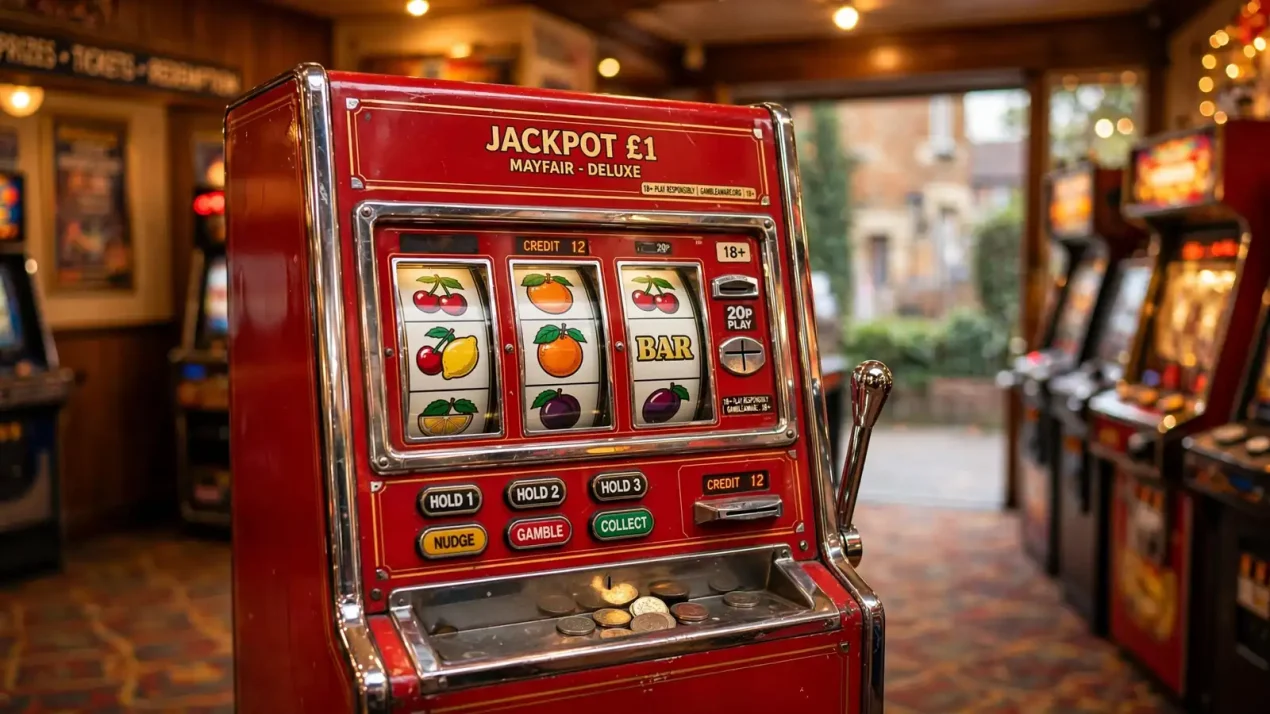
Fruit-themed slots borrow the visual language of arcade-style machines: bright fruit icons, bold colours and simple-looking reels. Cherries, lemons, oranges and plums are familiar examples, often set alongside symbols such as bells or sevens. That imagery can make a game feel recognisable at a glance, even when it is being played on a phone or computer rather than a physical machine.
The appeal is partly about readability. Fruit pictures are easy to distinguish, and their repeated appearance across the reels gives the screen a clear visual pattern. A player looking for fruit-themed games may prefer that uncluttered look to a title built around elaborate characters, story scenes or animated effects. The theme can also feel playful without requiring you to follow a plot or learn a fictional world.
But appearance is not a guide to what a game pays. A cherry symbol does not have a universal value, and seeing the same fruit on more than one reel does not by itself establish that a winning combination has landed. Each game sets its own rules for which symbols count, how they must appear and what a winning arrangement is worth. The paytable, rather than the familiar image, is where those details belong.
That distinction matters when a game resembles a physical fruit machine. A shared visual style does not mean that its rules, payouts or operation are identical to those of another game. Even games with similar symbols can treat them differently. One title might give a symbol a role in a feature, while another may use it only in ordinary combinations. The screen can suggest familiarity; it cannot replace the rules.
If you are choosing a fruit-themed game, look at the symbols and presentation as matters of taste, then check the game information for how combinations are evaluated. That keeps the decision grounded in what the title actually offers, rather than what its colours or icons seem to promise. A bright row of fruit may be pleasing to watch, but it is decoration until the rules assign it a function.
The same caution applies to searches for fruit machines with a compact reel layout. The fruit theme describes the look, while the reel arrangement describes another part of the game. Neither label tells you whether the game is generous, how often it returns money or what a particular symbol is worth. Those questions depend on the individual title, not on the fruit pictured on its screen.
A familiar design can still be a perfectly good reason to try a game, provided you treat it as an aesthetic preference. Just keep the symbols in their proper place: they identify a theme, not a promise.
What Slot Odds and Volatility Can—and Cannot—Tell You
Odds describe how likely an outcome is; volatility describes the pattern in which a slot’s returns tend to arrive. They answer different questions. A game may produce wins relatively often but in smaller amounts, or go longer between wins and sometimes pay larger amounts. Neither pattern tells you what will happen during a particular session.
Low-volatility slots tend to spread returns across many smaller wins. High-volatility slots tend to pay less often, with larger wins when they occur. “Low” does not mean that every spin is likely to win, and “high” does not mean a large payout is due after a run without one. Volatility is a broad description of how results are distributed, not a timetable.
Across most low-volatility titles, winning combinations typically appear on average every three to six spins. That average describes results across many outcomes; it is not a promise that a combination will arrive within that span for you. A session can include several wins close together, or a longer stretch without one. Random outcomes do not follow a schedule simply because a game has a stated volatility category.
A winning combination also does not, by itself, explain the value of the return. The label “win” identifies a game result, not whether it is large or small. So when comparing 3 reel slot machine odds, do not treat reel count or a frequent sequence of combinations as evidence of better returns. Look for the game’s own information about its odds and volatility, and read those as separate details.
Attention: Volatility is a broad description of how results are distributed and is not a timetable or a guarantee that a win is due after a run of losses.
Free three-reel games, including versions available without registration, can expose you to the same broad idea of volatility: outcomes may arrive in different patterns. But a short run of practice results cannot establish how often a game will produce wins over time. Nor does a handful of results prove that a title is low or high volatility. The game’s description is more useful for understanding its intended pattern; individual outcomes remain variable.
The practical limit is simple: odds and volatility can help you understand the kind of pattern a game is designed to produce, but they cannot forecast your next result. A label is not a promise, and an average is not a session-level guarantee.
Reels, Paylines and Bonus Features: Check the Actual Game
A three-reel layout tells you how the game is arranged; it does not tell you which features are included. Paylines, jackpots and bonus rounds are separate design choices. If you are comparing three-reel games or looking for one with extra features, check the rules for that specific title rather than treating a short reel layout as a feature list.
A payline is a route across the reels on which a symbol combination may count as a win. The rules should show how many lines are active, whether they are fixed or can be selected, and what combinations qualify. A game may look simple while still having rules that take a little reading. The reel count alone cannot tell you how a win is formed.
Bonus features need the same scrutiny. Check what triggers a round, what happens during it and how any multiplier works. A multiplier changes a qualifying win according to the game’s rules; it does not mean every spin receives a bonus. The title’s paytable and help screen are more useful than assumptions based on its appearance or format.
Low-volatility slots typically have a different feature profile: they use five reels and at least twenty-five paylines, with fixed jackpot amounts rather than progressive pools. Their bonus rounds typically use multipliers on accumulated wins. These are characteristics associated with low-volatility titles, not a template for three-reel games. A three-reel game should not be presumed to have a particular number of paylines, a fixed jackpot or a multiplier round.
The same applies when viewing a free version. Its displayed rules can help you inspect the layout and available features, but the game’s own information remains the place to check how those features operate. Do not assume that a free title has a bonus simply because other games in the same broad category do.
Before choosing a game, look for its paytable, feature descriptions and any stated jackpot terms. If those details are unclear, the reel arrangement cannot fill in the gaps. Two games with the same number of reels can have different rules; the features belong to the individual game, not to the format.
Browser Play Without a Download
A browser-based slot can be opened on a compatible phone, tablet or computer without installing a separate app. You visit the casino site, find the game and open it in the browser. That can be useful if you do not want another app taking up space or would rather try a game before deciding whether to keep using the site.
Availability depends on the operator and the game: not every title will offer a free mode, and some sites may ask you to sign in before you can access one. Check that you have selected the practice version before starting. A free game uses fake money; it does not award cash or create winnings you can withdraw. A convincing screen does not change that distinction.
Browser play is practice, not a route to real-money winnings. It can show you where the controls and game information appear, but it does not give you a balance that can be transferred to a bank account. If a page describes free play as a way to earn withdrawable money, read its terms carefully before proceeding.
A no-download option also does not mean a game is outside the rules that apply to the casino site. In Great Britain, operators offering remote gambling to consumers must hold the relevant UK Gambling Commission licence. You can check the operator against the Commission’s public register rather than treating a polished game screen as proof of its status.
The browser itself does not determine a slot’s odds. Those belong to the individual game, whether it is opened in a browser or through an app. Nor does playing without installing anything make a free version equivalent to real-money play: the practice balance is not cash, and no payout is available from it.
For a search for three-reel slots without a download, the practical point is access: a browser may let you open a compatible title directly, while avoiding an app installation. Confirm whether the game is in free mode or real-money mode before you play, and do not mistake the former for a source of winnings.
Traditional Play, Session Limits and Strategy Claims
Traditional three-reel slots can encourage a simple routine: choose a game, decide how long to play, and stop when the session ends. That kind of structure can help keep play within boundaries you have chosen. It does not change how the game works, and it should not be confused with a system for making a slot pay.
A strategy may suggest changing your stake after a win or loss, following a sequence, or stopping once a particular result appears. Such rules can shape your decisions, but they cannot make past spins influence future ones. A run of losses does not make a win due, and a recent win does not mean another is more likely. A routine can organise a session; it cannot control the outcome.
Set a time limit and a spending limit before you begin, and treat both as firm stopping points rather than targets to recover. If you reach either, stop instead of extending the session to get back to an earlier balance. Taking a break can help you notice whether you are still following your plan, but it does not improve the odds. The useful purpose of a limit is practical: it puts a boundary around play.
Claims that a strategy can beat a slot need to be judged against the game’s underlying mathematics. A house edge is the casino’s mathematical advantage in a game. Where a slot has a positive house edge, the player’s expected result is negative over enough sessions. This remains true whether losses arrive quickly or accumulate gradually. A short session can end in a win, but that possibility does not overturn the longer-run expectation.
RTP Casino Slots in the UK: How Returns Work
Searching for a traditional style or a no-registration option does not make a strategy more reliable. Registration terms and access conditions are separate from the game’s outcome, so check what applies before playing. Most importantly, do not mistake a disciplined routine for a way to secure a return. Limits can help you decide when play ends; they cannot make a slot profitable.
This material was created by the Spreadex Casino UK team.
Related posts

Top Rated Online Casinos UK: What Ratings Mean

Wazdan Online Casinos UK: What Can Be Verified
